What is the Sequence of Operation of LBB Protection?
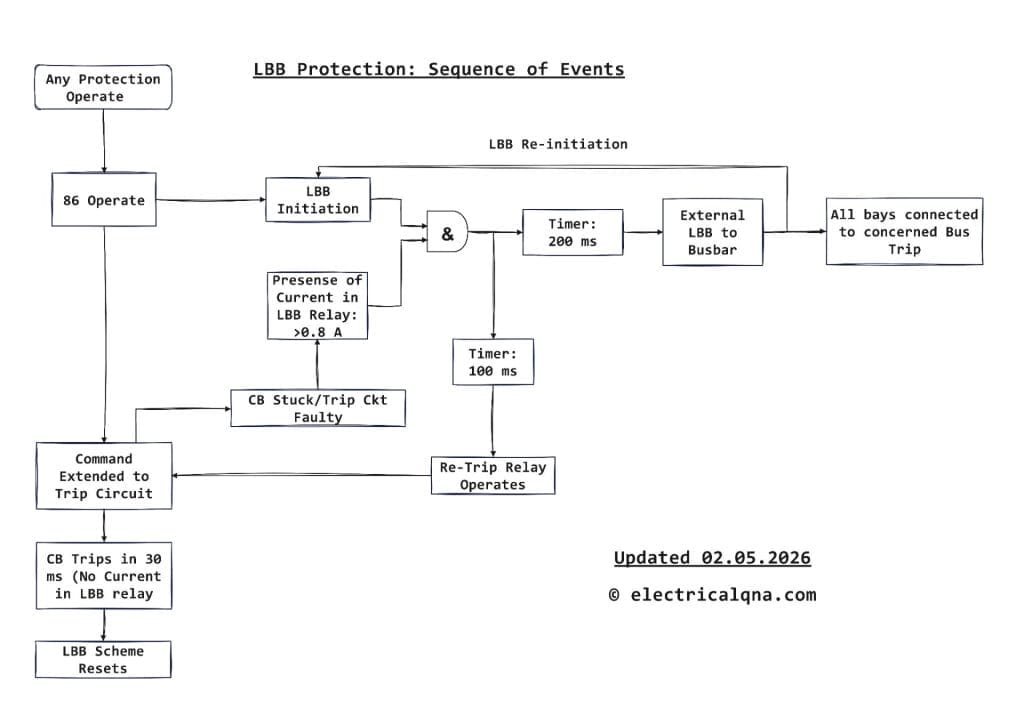
- Fault: A fault occurs on Line 1, and Distance Protection (Zone-1) operates at both ends.
- Master Trip Relay (86) Operation:
Master Trip Relay Operates and the trip command from the Master Trip Relay is simultaneously extended to the Circuit Breaker trip circuit and to the LBB relay, thereby initiating the LBB scheme (LBB Initiation) - Circuit Breaker Response:
Now, either CB Trips within say 100 ms or the CB does not Trips because of the Mechanical Problem (CB Gets Stuck) or CB Trip Circuit Faulty (86 Contacts Faulty, Trip Coil Faulty, etc.)
If the CB Trips (<100ms), there is no current in the LBB Relay , the LBB Scheme resets. - Breaker Failure Condition:
If the CB fails to Open in say 100 ms, , the fault current continues to flow and so there will be presence of Current in the LBB Relay. - LBB Detection Logic:
If LBB initiation is present along with the presence of current in the LBB relay greater than the set threshold (typically >0.8 A secondary), the LBB logic confirms breaker failure and initiates a Timer. - Re-Trip Operation:
After a preset time delay (approximately 100 ms), the re-trip relay operates and issues another trip command to the same breaker, providing an additional opportunity for successful tripping. - LBB Operation:
If the CB still fails to open even after the re-trip command, the LBB timer continues, and after an additional delay (approximately 100 ms), an external LBB command is extended to the busbar protection scheme (External LBB to Busbar).
All the Bays Connected to the Concerned Bus get Tripped and the Fault is Isolated.