Substation Automation System (SAS): Field-Oriented Practical Q&A
Introduction to Substation Automation System (SAS)
Q1. What is a Substation Automation System (SAS)?
A Substation Automation System (SAS) is an integrated system used to monitor, control, protect, and automate electrical substations using Intelligent Electronic Devices (IEDs), communication networks, and SCADA systems.
Q2. What are the main objectives of SAS?
Answer:
- Remote monitoring and control of substations
- Faster fault detection and isolation
- Reduction in manual operation
- Improved reliability and availability
- Integration with SLDC/ALDC/Control Centers
Q3. What are the functional levels of SAS?
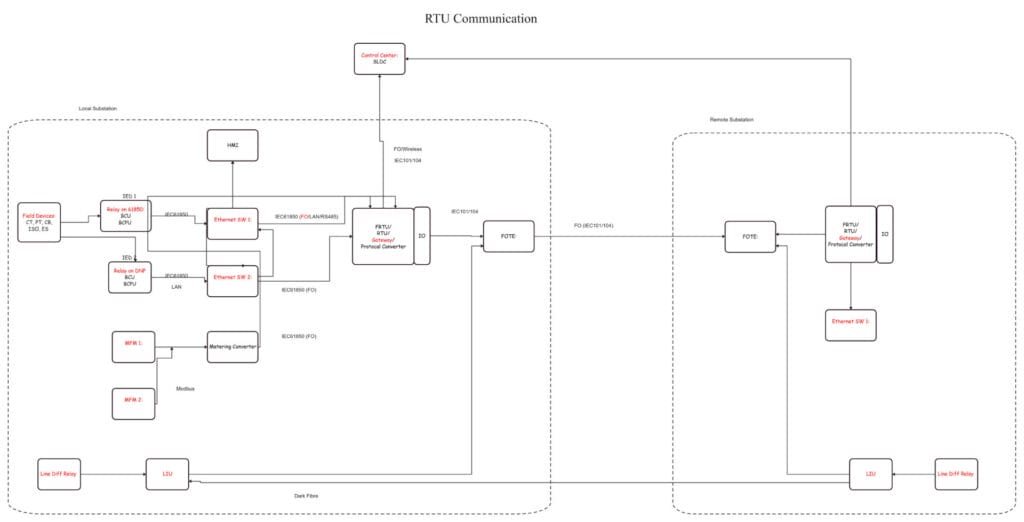
Process Level – CTs, PTs, breakers, isolators
Bay Level – Protection IEDs, Bay Control Units (BCU)
Station Level – HMI, Gateway, RTU, Engineering PC
Q4: Signal Information Type?
A:
- Single Point (SP)
Example: Master Trip Relay Operated - Double Point (DP)
CB ON & OFF Status, CB Control, Isolator (2 Nos.) - MEFL- Measurement Float
- MEI
Communication Fundamentals:
Q5: What is a Communication Protocols?
A: A protocol defines the structure, contents and procedures how to exchange data between computers/ IEDs over a network media.
Protocols ensure standardized, reliable, and interoperable communication between devices from different manufacturers.
Q6: What are common SAS Communication Protocol?
A:
Common SAS protocols based on communication method are follows
Serial Protocols: Serial communication sends data one bit at a time sequentially.
IEC60870-5-101: Control Center Protocol
IEC60870-5-103: Protection Device Protocol
Modbus RTU: Process Information Protocol
Ethernet/ TCPIP Protocols: Ethernet is a LAN technology defined by IEEE 802.3 using CSMA/CD.
IEC 60870-5-104
IEC 61850
Q7. What is serial communication?
Serial communication sends data one bit at a time sequentially.
Q8. What serial standards are used in SAS?
● RS-232
● RS-485
● Optical fiber serial links
Q9. What are RS-232 characteristics?
● Point-to-point communication
● Distance limited to 3–15 m
● Voltage referenced to ground
Q10. What are RS-485 characteristics?
● Differential signaling
● Distance up to 1200 m
● Supports multi-drop communication
Q11. What is Ethernet?
Ethernet is a LAN technology defined by IEEE 802.3 using CSMA/CD.
Q12. What is a LAN?
A LAN connects devices within a building or campus with high speed.
Q13. What is a WAN?
A WAN connects geographically separated LANs over long distances
Q14. What is IEC 61850?
IEC 61850 is an international standard for substation communication enabling interoperable, object-oriented communication over Ethernet.
Q15. What communication services are defined in IEC 61850?
MMS (Manufacturing Message Specification)
GOOSE (Generic Object Oriented Substation Event)
Sampled Values (SV)
Time Synchronization
Q16. What is GOOSE communication?
GOOSE is a fast Layer-2 multicast protocol used for protection, tripping, and interlocking.
Q17. What is MMS communication?
MMS is a client-server protocol over TCP/IP used for SCADA monitoring and control.
Q18. What are Sampled Values (SV)?
SV transmits analog CT/PT values over Ethernet for process bus applications.
Q19: What are Communication Types in IEC 61850 based on its purpose?
A:
- For Fast Messaging- GOOSE (Protocol: Layer 2 Ethernet)
- For SCADA Communication (Monitor/Control)- MMS (Manufacturing Message Specifications) (Protocol: Layer 7 TCP/IP)
- For Analog value transmission over process bus Analog Data (CT/PT)- SV (Sampled Values) (Protocol: Layer 2 Ethernet)
OSI Model and Protocol Mapping
Q20. What is the OSI model?
The OSI (Open Systems Interconnection) model is a 7-layer reference framework used to understand and design communication systems.
Q21. List the seven OSI layers.
Physical
Data Link
Network
Transport
Session
Presentation
Application
Mnemonic: All People Seem To Need Data Processing
Q22. How does Ethernet map to the OSI model?
Ethernet defines only Layer 1 (Physical) and Layer 2 (Data Link).
Q23. How does Ethernet with TCP/IP map to OSI?
Layers 1, 2, 3, and 4 are defined; Layers 5 and 6 are unused; Layer 7 depends on application.
Client–Server and Master–Slave Concepts
Q24. What is client–server communication?
In client–server communication, the client requests data and the server responds.
Q25. What is master–slave communication?
In master–slave communication, the slave responds only after a valid query from the master.
Q26. What is CASDU?
CASDU is the RTU address used in IEC 60870-5 protocols.
Network Topology:
Q27. What is network topology?
Network topology defines the physical or logical arrangement of devices in a network
Combination of all the Protocols.
Q28: What topologies are used in SAS?
Answer:
- Star Topology: All devices are connected to a central switch. Failure of one link affects only that device.
- Ring Topology: IEC 61850/RSTP/HSR
Devices are connected in a closed loop and used with RSTP, HSR, or PRP - Bus Topology
All devices share a common communication line with terminators at both ends
Q29: What are Redundancy Protocols?
Answer: PRP, HSR
They provide zero recovery time and no packet loss, ideal for GOOSE and SV traffic
Q30: What is PRP?
Answer:
PRP is Parallel Redundancy Protocol.
- Two independent networks send duplicate packets simultaneously.
- End nodes select the first-arriving packet
Q31: What is HSR?
Answer:
HSR is High-availability Seamless Redundancy
- A Single Ring where each node forwards frames both ways
- Zero Recovery time (Ideal for GOOSE/SV traffic)
Communication Media used in SAS:
Q32: What communication media are used in SAS?
Answer:
- Fiber Optic Cable (Single Mode & Multi-Mode)
- Ethernet Cables (Cat5, Cat6, Cat7)
Q33. What are the advantages of optical fiber?
● Long distance communication
● Immune to electromagnetic interference
● High bandwidth
● Electrical isolation
Q34.What is single-mode fiber?
Answer:
- Single-mode fiber uses laser light, has a small core, and supports long-distance communication (up to 40 km or more)
- Even though Speed of the Data Transfer is fast, still the Data Transfer is slow, as there is only one Mode.
- Usually done between One Substation to Other Substation.
Q35.What is multi-mode fiber?
- Multi-mode fiber uses LED light, has a larger core, and supports shorter distances (up to ~1 km).
- As there are multiple Modes, Data is transferred Faster.
- Usually done between One Substation to Other Substation.
Networking Devices
Q36: What is a HUB?
A: A hub is a Layer-1 device that broadcasts data to all connected ports.
Q37. What is an Ethernet switch?
A switch operates at Layer-2 and forwards data using MAC addresses.
MAC (Media Acess Control) Adress
Works on Layer 2.
MAC Address cannot be changed
Q38. What is the difference between managed and unmanaged switches?
● Managed: VLANs, SNMP, redundancy, monitoring
● Unmanaged: Plug-and-play with no configuration
Q39. What is a router?
A router operates at Layer-3 and routes data between different networks using IP addresses
PAS (Power Automation System)
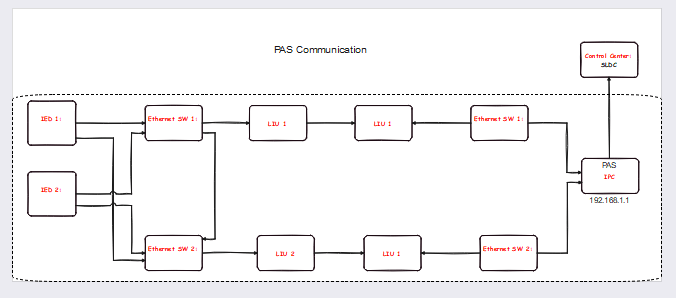
Q40.What is PAS?
A: It is like a Data Concentrator which is completely Software based and there is No Hardware like in RTU.
Multiple Protocols can be used.
Q41. What licensing methods are used in PAS?
● Dongle-based license
● Soft license
Q42. What are the main PAS functions?
● UI configuration and mapping
● UI operation
● Value viewer
● Feature enable
Q43. Were are the Signals used?
- Single Point (SP):
Alarm Logging: Required
Tag Management: Required
Tag Logging: Not required - Double Point (DP):
Alarm Logging: Required
Tag Management: Required
Tag Logging: Not required - MEFL:
Alarm Logging: Not Required
Tag Management: Required
Tag Logging: Not required - MEI:
Alarm Logging: Required
Tag Management: Required
Tag Logging: Required