What is the basic concept of Power System Protection?
Protection system is the most critical part of the Power system and needs to be handled with utmost care.
What is the main objective of Power System Protection ?
Ans: Isolate the faulty Section from the Live System to prevent the flow of Fault current through the system, so that there is no interruption in the Power supply.
This involves quickly disconnecting the fault path, ensuring that the rest of the network remains operational.
What are the basic components of the Power system protection ?
Ans:
1) Instrument Transformers (CT & PT): Measures the electrical parameters and gives to the Relays.
2) Protective Relays: Process the Inputs signals given by the Instrument Transformers and Operates the Master Trip Relay.
3) Master Trip Relays (86): When Operated Trips the Circuit Breaker.
4) Circuit Breakers (52): Opens the Faulty Section.
5) Battery (DC Supply): Provides DC to all the devices involved.
How does the Protective System Operate?
Ans:
1.The Secondary of the CT & PT are connected to the Current & Voltage Coil of the Relay respectively. So the CT & PT continuously gives Current & Voltage input to the Relay.
2. The Relay keeps on processing the inputs from the CT/PT all the time.
3.The Relay is Set for a particular value of Voltage/Current.
4. During the Normal Operating condition, the measured parameters are within the limits of Set parameters and so the relay and thereby the Breaker remains in the reset position.
5.During Fault/Abnormal System Conditions, the input to the Relay (Current/Voltage) exceeds the set value and so the Relay Operates.
6.The Protection Relay Operates the Master Trip Relay (86), which inturn Trips the Circuit Breaker, Isolating the Faulty Section.
What are the main requirements for Power system Protection?
Ans:
1) Reliability: Power System Protection is very Critical and so it needs to operate most of the times.
2) Selectivity: Protection system should operate for a specific condition and restrain from operation in some other conditions
3) Sensitivity: Protection system must be sensitive enough to operate even when the measured parameters just cross the set values.
4) Speed: Protection System must Operate as fast as possible or we can say as per the set time.
What is the primary function of protective relays?
Protective relays are designed to detect abnormal conditions in an electrical power system and initiate corrective actions, such as isolating faulty sections to prevent damage to equipment and ensure system stability.
What are different relays used in Power System Protection?
Ans: For Transmission Lines: Distance Relay, Overcurrent relays, Line Differential Relays
For Transformer: Differential Relays, Overcurrent Relays
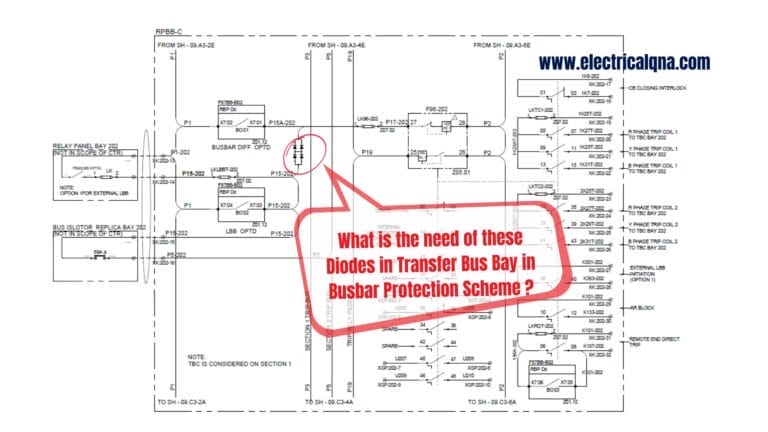
For Busbar: Busbar Differential Relays.
What are the key functional requirements of protection relays?
The key functional requirements include reliability, selectivity, sensitivity, and speed. These ensure that relays operate correctly under fault conditions without causing unnecessary disruptions.
What is the role of circuit breakers in power system protection?
Circuit breakers automatically disconnect the faulty part of the system during a fault, ensuring the stability and safety of the remaining electrical grid. They are crucial for isolating faults quickly.
What is the difference between primary and secondary relays?
Primary relays are connected directly to the protected circuit, while secondary relays are connected through current and potential transformers to assist another relay in performing its function.
What does the term “pickup value” refer to in the context of relays?
The pickup value is the actual value of the energizing or characteristic quantity at which the relay is designed to operate, indicating the threshold at which the relay will activate.
What is the significance of station batteries in power systems?
Station batteries provide the necessary DC power to operate circuit breakers during power failures, ensuring continuous protection of the power system even when AC power is unavailable.
What is meant by “overreach” and “underreach” in relay measurements?
Overreach refers to errors in relay measurement that result in incorrect operation, while underreach refers to errors that lead to failure to operate when needed.
What types of faults can occur in a power system?
One of the most common faults is a short circuit, which can arise due to equipment failure or insulation breakdown, leading to an abnormal flow of current.
How does coordination between protective devices enhance system reliability?
Coordination between protection devices is crucial for enhancing the reliability of an electric power system. By implementing an effective protection scheme, electrical engineers ensure that when a fault occurs, the right protection device activates within its designated zone of protection. This minimizes the impact on the overall power grid while ensuring optimal fault protection.
What are the latest advancements in power system protection technologies?
New methods utilize current transformers and advanced impedance algorithms to improve the reliability of distance protection and differential protection, ensuring that overcurrent protection is more effective.